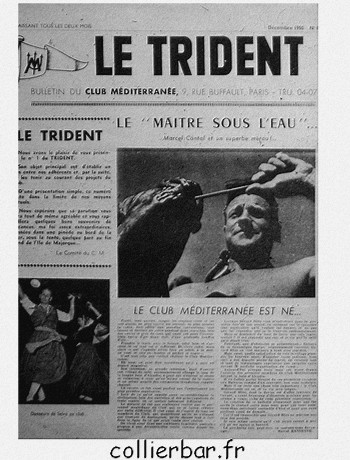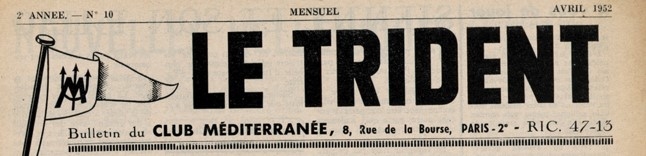
At the end of the first season, Club Méditerranée felt it necessary to publish a small newsletter to inform members about the association's activities. The first issue was published in December 1950. Marcel Hansenne wrote the editorial.
From the small information sheet to today's large catalogue
Comprising 4 to 8 pages depending on the issue, it had a print run of 30,000 copies two years after its first publication. It was published bimonthly (approximately one issue every two months). Jean Maubert was responsible for the publication.
These first Tridents cover various club news items, new villages, and also offer advice and other recommendations for the GMs (Gentils Organisateurs - Club Members). A section for wedding and birth announcements is also included!
The Trident doesn't shy away from self-criticism, pointing out where things aren't working within the club and assuring everyone in charge (Gérard Blitz first and foremost) that solutions will be found to improve the GMs' experience.
There are also some advertisements, or rather, publicity ads back then. Some of them even indicate that GMs are welcome at store x or store y and will sometimes be entitled to preferential rates.
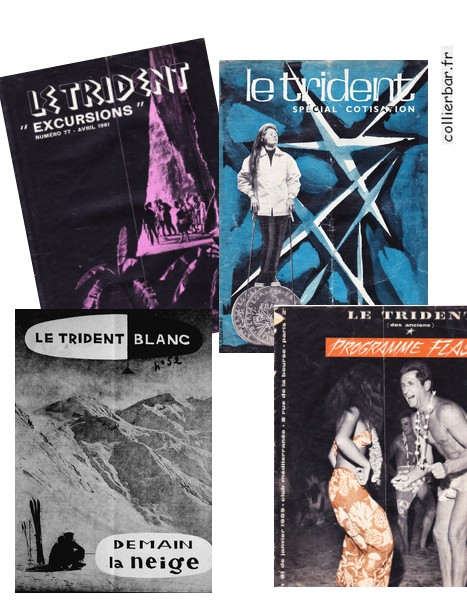
In 1957, after merging with the Village Magique club, Paul Morihien took over the publication of Trident. Trident was transformed, abandoning its newspaper format to become a small magazine with a cover that gradually adopted color. The interior remained black and white.
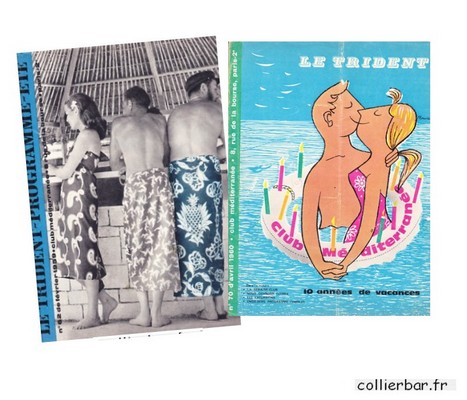
The talent of various illustrators, both GMs and GOs, frequently graced these issues. Among them were drawings by Maurice Sinet, better known as Bob Sine, and Raymond Peynet, who also contributed, creating the little fish character Anatole.
The magazine comprised approximately twenty pages. It included information on trip organization (self-assessment was always presented to GMs), descriptions of the villages, including the one that had received the "Oscar of the Year" award, special features such as those by Jean Albert Foex and texts by Jean de Baratti (Jean Balandjian), as well as reports on major festive events like the Club's nights.
During this period, Club Med published several special issues throughout the year, such as the Trident des Anciens, the Trident spécial cotisation, the Trident spécial excursions, the 10th anniversary issue, the Trident Blanc, and the Trident Service Club.
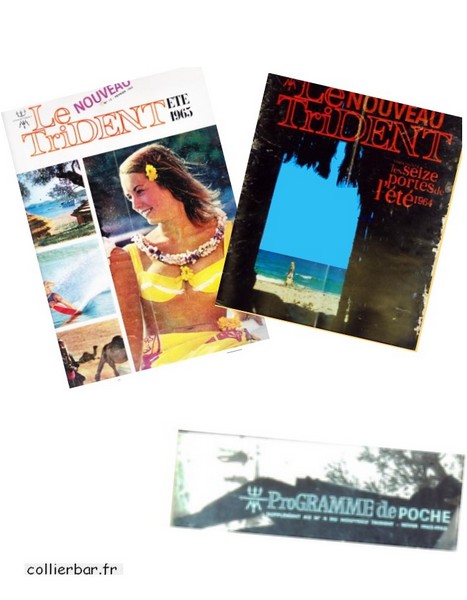
In 1964, a revolution took place as the magazine changed its format and was briefly called "Le Nouveau Trident" (The New Trident). The same themes remained, but in a new format with large photographs and illustrations by André Escaro. A pocket-sized edition and a guide in the style of the Michelin Green Guide, indicating sites to visit and routes to explore in various Mediterranean countries, were also published
These experiments will not last and the Trident of the new era will appear in 1966. This Trident of the late sixties is almost the same Trident we know today, with a few minor differences.
From 1966 onwards, Trident magazine not only modernized with fully color editions but also expanded internationally with the publication of foreign editions in the early 1970s to better reach international GMs (Germany, US, Israeli, and Japanese). Its publication frequency also changed, now appearing only twice a year (Summer Edition, Winter Snow/Sun Edition). Its editorial line remained the same, but its size evolved as new villages opened. The magazine typically included a list of villages, a few pages about the club with new features, and then a detailed presentation of each village, complete with full-page text and photos. The prize book was included at the end before becoming a separate publication in the late 1990s.
The layout adopted landscape mode between 1973 and 1978. The return to portrait mode was then reintroduced.
The good old advertisement, visible during the 1950s, gave way to advertising for products bearing the "Club Med boutique" label and was relegated to the end of each issue.
Changes to the price list:
Whether attached to or detached from the Trident, the section dedicated to holiday prices has also evolved. Here is a brief history.
In the early Trident brochures, prices for a three-week stay were listed in old French francs (sic!). They appeared on the village page in a section titled "General Information," accompanied by a box indicating departure dates.
During the 1960s, they were grouped on the last page of the Trident, on a special "General Information" page. There, prices were listed in new francs. It wasn't until the publication of the modern editions in 1966 that a proper price guide appeared. Initially inserted in the middle of the Trident, it was later moved to the end of the brochure.
In the late 1990s, the price list, which switched to euros in 2002, was published as a separate guide from the Trident.
Today
Today, the Trident is available in several formats and nearly 25 different languages. In print, of course, but also, thanks to the rise of new digital media, as a downloadable digital format.
Two things, however, have not changed over time: the pleasure of leafing through it and the escape it provides to the reader.