
The Club's Growth
In 1960, the club celebrated its 10th anniversary. The celebration took place at the Moulin de la Galette and the Salle Pleyel. The renovated Djerba resort reopened with great fanfare after Tunisia gained its independence in 1958 and tensions between Tunisia, France, and Algeria had eased somewhat. This new decade allowed Club Med to develop and grow through acquisitions (such as Voir & Connaitre in 1967 and CET in 1970) and by expanding its reach further each year.
And to think that this growth could have been cut short. It's the early 1960s, and Club Med is in dire straits. The formula is working well, but it's not covering all the investments made. The Club is going into debt. It's on the verge of bankruptcy. In 1963, Gilbert Trigano takes over the presidency, which was initially intended to be a rotating presidency (one year Gilbert Trigano, the next Gérard Blitz, and so on). This rotating presidency was never implemented because it was forgotten. The Club's savior is Edmond de Rothschild. He buys 35% of the company's shares and allows Club Med to get back on its feet. The Club is saved and can continue its development.
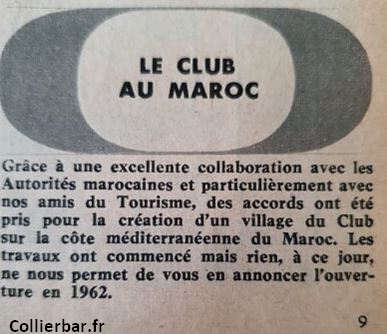
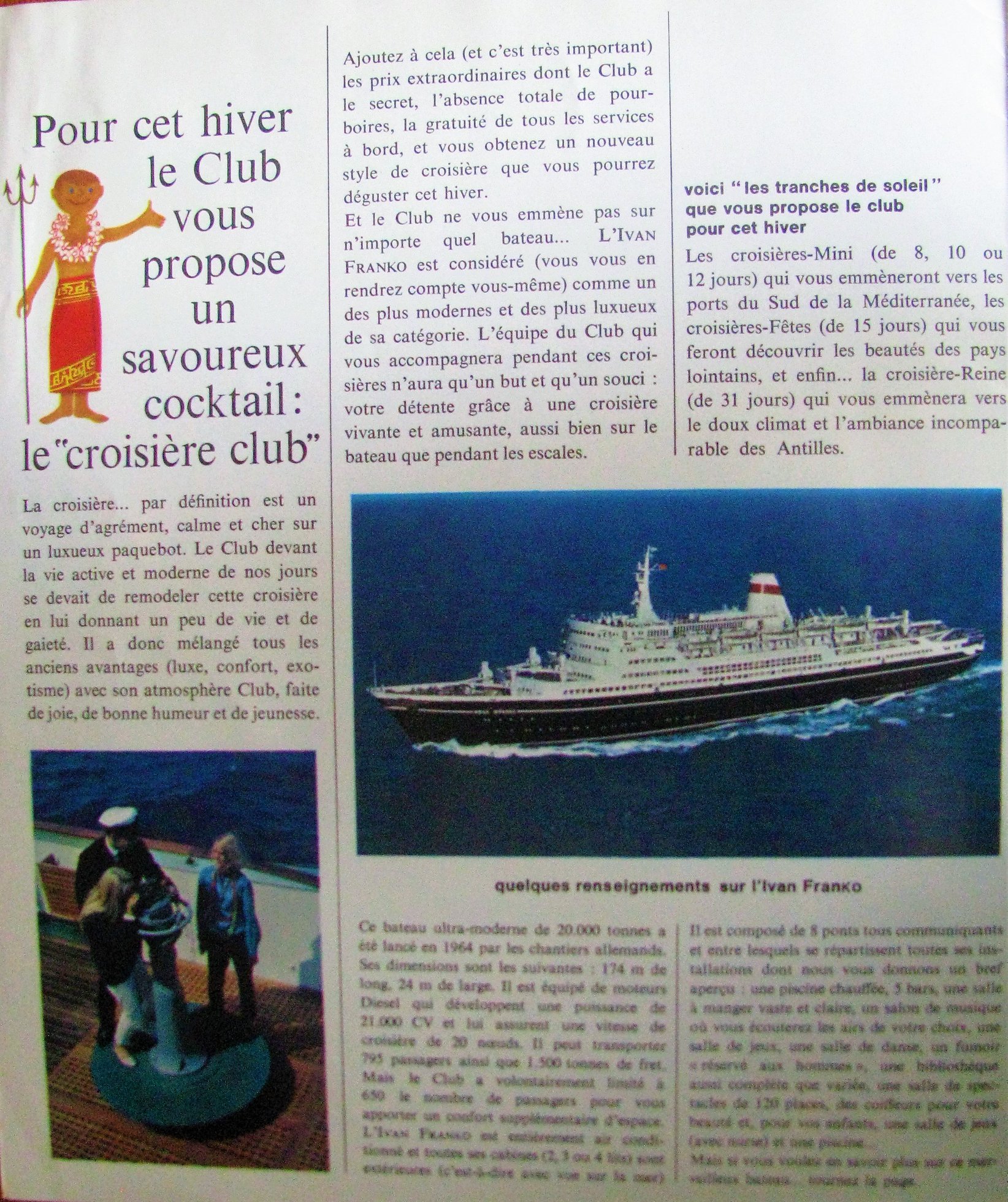
Among the most striking (and audacious) examples are the openings of the Arzhiv villages in Israel in 1961, followed by Al Hoceima in 1963, and Agadir in 1966, thanks to a growing friendship with the Kingdom of Morocco, while the city was still rebuilding after the devastating 1960 earthquake. Equally audacious was the conquest of the Eastern Bloc. Club Med brought down the Iron Curtain while the Cold War raged. Sochi in the USSR in 1965, villages in Romania and Bulgaria (Thalassa, Nesebar, and then Rousalka), and the famous Ivan Franko, a Soviet merchant marine cruise ship flying the Club Med flag, which, starting on December 20, 1965, took guests on cruises to Rhodes, Malta, and Egypt—26 years before Club Med One!.
The club barely experienced the May 1968 revolution. A few internal discussions took place between the GOs (Gentils Organisateurs) and Gilbert Trigano, along with the creation of an independent union, but these didn't stop the GMs (Gentils Membres) from leaving to discover beaches beyond the city's cobblestone streets. After Eastern Europe, Club Med set its sights westward, beginning with the Caribbean. Fort Royal in Guadeloupe and Les Boucaniers in Martinique opened the same year the fighting erupted in the Latin Quarter. The following year, a snow village opened in Bear Valley, California, in the United States.
At the dawn of the 1970s, Club Med boasted 28 resorts spread across four continents, having acquired Connaissance du Monde and Voir & Connaitre. It was well-positioned to face the challenges of the decade.
70 The years of total happiness.
The decade began with the acquisition of CET (European Tourism Club), Club Med's most direct competitor. Most of CET's resorts were then incorporated into Club Med's portfolio, including Kusadasi in Turkey, Malabata near Tangier, Cargèse in Corsica, and others. During these years, Club Med opened up to three resorts per year. It established itself in sub-Saharan Africa, first in Assinie, Ivory Coast, then in Senegal, Central America, the Indian Ocean, and so on. Each country wanted Club Med to open a resort within its borders.
The range of sports offered also expanded. Golf and windsurfing were introduced. "Forums" were established in several villages. These forums offered activities such as conferences and performances by guest artists. François de Closet gave lectures, and the Splendid troupe of L'Hermite, Blanc, Jugnot, and others were invited. They drew inspiration from their stays at the Club to release the film "Les Bronzés" in 1978. The film was a box office hit. It depicted life at the Club in a certain way, but the story itself was based on true events.
In terms of advertising (posters and TV), Club Med did not go unnoticed. The campaign, known as the "play," "laugh," "love," and "leave" campaign, set against a backdrop of idyllic scenery, was rolled out across France. In 1976, Jacques Séguéla came up with the slogan that still serves as the basis for all advertising campaigns today: "The Club, the most beautiful idea since the invention of happiness.".
Throughout this period, there was also a liberation in terms of morals. Conditions changed, the atmosphere of the villages changed; some villages, like Sveti Marko, became more natural. And then, let's be honest, AIDS was unknown. No need to say more, you understand.




Videos
Club Med – Vacation Time
Editing: Gérard DECOSTERD (Pigeon)
Collierbar Archive
Relaxation and leisure club – 1982
Part of the 1982 film shot by Poï Chevalier.
Editing: Gérard Decosterd (Pigeon).
Collierbar Archive


Hello, as a former sound engineer (between 1966 and 1968), I have a few recordings: a presentation of the sound engineers by Gilbert Héron, and part of the symposium that took place in Zinal at the end of winter 1968.
Are you interested? And in which section could I send them to you?
Thank you.