
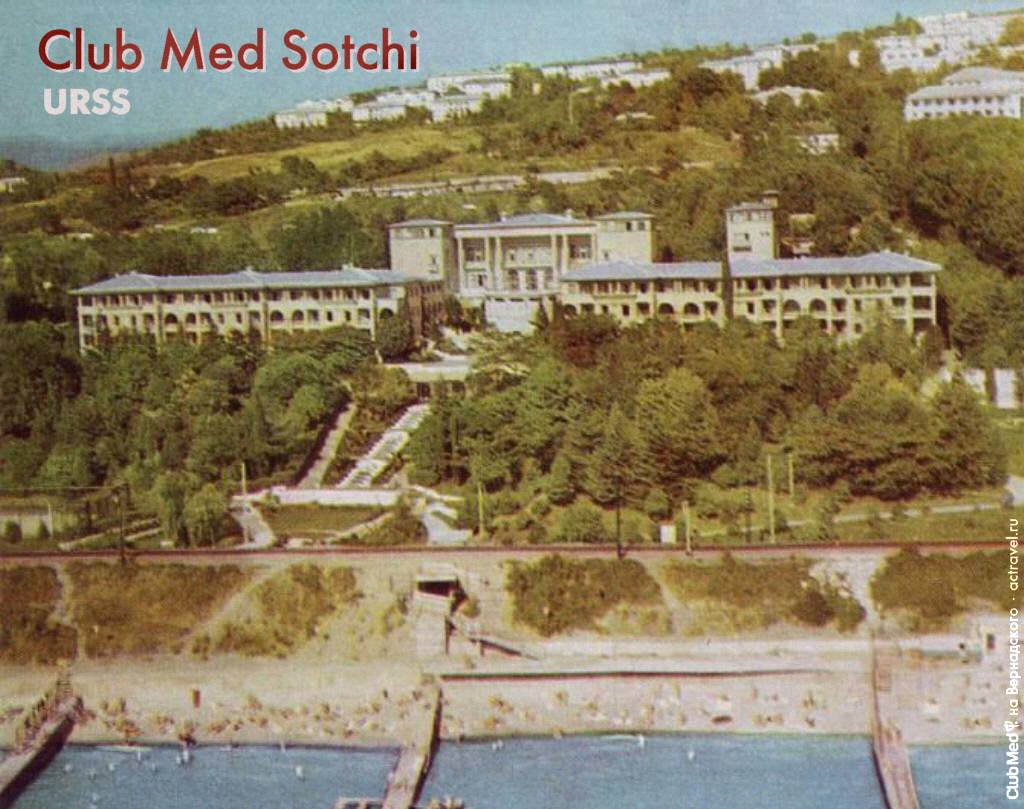
In 1966, Club Med crossed the Iron Curtain and established itself in the USSR in Sochi, on the Black Sea coast. The previous year, Gilbert Trigano had accepted an invitation from Minister Ankoudinoff. The visit allowed Gilbert to discover the cities of Odessa, Yalta, and Sochi, which he fell in love with. He reached an agreement with the Soviet authorities to establish a Club Med village. This was accomplished in 1966.
Two twin hotels had just been built in this Black Sea resort nicknamed "The Saint Tropez of the USSR". Following the agreement, the Soviet state had therefore authorized Club Med to manage one of the hotels, while the other would go to Intourist (the official tourism organization in the USSR).
The village opened in May 1966. Most of the GMs (Gentils Organisateurs, or Club Med staff) were French and Belgian. Pierre-Jean Laplace was appointed Village Chief and surrounded himself with a few GOs. Water skiing, unknown on the Caucasian Riviera, was offered among the village's activities. As an interesting side note, the Russian speedboat driver discovered this sport for the first time. According to accounts, his piloting was very clumsy, but he was unavoidable.
When party officials wanted to assess the situation after a few months of operation, they were struck by the enormous difference between the two hotels. The first was full of color, flowers, and life, offering abundant buffets and festive atmospheres with crazy signs, while the second was gray, gloomy, and dreary. Moscow's decision was swift: Club Med had to close. This kind of model was not in line with the party's policies.
Club Med's involvement with the Eastern Bloc wasn't over yet. Satellite countries like Romania and Bulgaria would also have Club Med villages on their soil. The last Eastern Bloc village, Rusalka in Bulgaria, closed in 1996, this time for reasons unrelated to the country's politics.



Ivan Franko 1967

The last season in Rusalka, Bulgaria was in 1997, village chief Christian Chevrier
The village of Sochi was located on the current site of the Swissotel Resort Sochi Kamelia, the buildings were razed to make way for it but the tennis court and the external facilities between the hotel and the railway below remain.